
Positional Vertigo

Benign Paroxysmal Positional Vertigo (BPPV) is a common form of vertigo that most people know as being caused by ‘crystals in the ear’.
The vertigo has some very characteristic features that make it easily recognizable. It comes on suddenly, often as a severe room spinning vertigo. It is triggered by a movement such as rolling over in bed, getting out of bed or bending over. There is usually a short delay before the vertigo starts and it eases again within 1 minute from the time you stop moving. It is possible for BPPV to be more subtle, without the severe vertigo. In these cases, people complain of an unsteadiness and feeling ‘not right’.
From the research we know that several factors appear to coincide with BPPV and increase the risk, but we can’t say for certain if they cause it. BPPV may occur because of the following:
Infection in the ear or sinuses
Neurological conditions such as migraine, stroke and multiple sclerosis
Knocks to the head
Low vitamin D and osteoporosis
Degenerative changes. Prevalence increases with age over 55yo.
After surgical procedures or very deep sleep lying in one position for a long time.
Anatomy
Understanding the anatomy of the inner ear helps to explain the pattern of symptoms with BPPV. Others have created images of this system which you can find elsewhere online if you search some of the unusual names below.
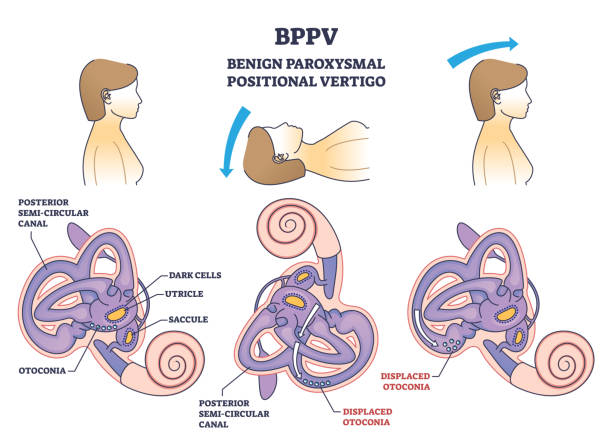
Behind our ear drum lies a very small, complicated organ that we call the vestibular system. The cochlea that gives us our hearing lies next to it. The vestibular system is made of a series of 3 semicircular canals that lie in each of the 3 planes (vertical, horizontal and depth). These canals are filled with a fluid that is thick like runny honey. When we move or stop quickly, the fluid movement has a small delay and gives us our sense of inertia. A hair cell (called the Crista) lies within the fluid, like seaweed in the ocean, and measures this movement. Normally there are no crystals in this system.
The utricle and saccule are small organs that are connected to the semicircular canals and give us our sense of movement compared to gravity, e.g. a head tilt. Small calcium carbonate crystals move with gravity, and hair cells again measure the movement.
The problem is when some of the crystals within the utricle and saccule wander from where they should be and end up floating in the semicircular canals. Now the seaweed in the ocean has a rock stuck to it that creates a sense of BIG movement. The crystals move in the fluid with inertia and settle again when the movement stops. This matches the pattern of dizziness that is triggered with movement after a short delay, and stops in 10-40sec when the fluid settles.
The role of physio
Physiotherapists, especially those trained in vestibular rehabilitation, are perfectly suited to treat BPPV. We complete a comprehensive assessment to diagnose the cause of the dizziness, and if it is BPPV, we can treat it with simple maneuvers.
When we know which, semicircular canal is at fault, we use simple sequences of head positions to move the crystal through the canal back to where it belongs. It might take a couple treatments to move all the crystals, but people usually feel better after each treatment.
BPPV can resolve on its own with time. This may be because the crystals have found their own way out of the canals. Or it may be because the body has found ways to compensate and avoid triggering dizziness. When we have dizziness, we instinctively hold our heads and necks very still. We turn our whole body rather than turning our head and we take more care with things like crossing the road or scanning the supermarket aisles while shopping. These are helpful short-term solutions but are not healthy in the long-term. This guarding increases stiffness, and reduces confidence, balance and mobility.
Once we have repositioned the crystals, we use simple vestibular rehabilitation to undo the protective habits. These exercises help rebuild neck movement, confidence and balance after vertigo. In people who are prone to getting BPPV we can sometimes teach them how to treat it at home. There may be some stubborn cases where they still need help.
BPPV is a severe vertigo that puts people in bed for days, but it can be treated safely and simply. If you know anyone who suffers from it, mention to them that physio can help.


Comments